


Study in Japan from Pakistan 2026–2027: Complete Guide to Universities, Scholarships, Visa, Fees & Requirements
Last Updated: | By: Career Connection Consulting | Reading Time: 20 minutes
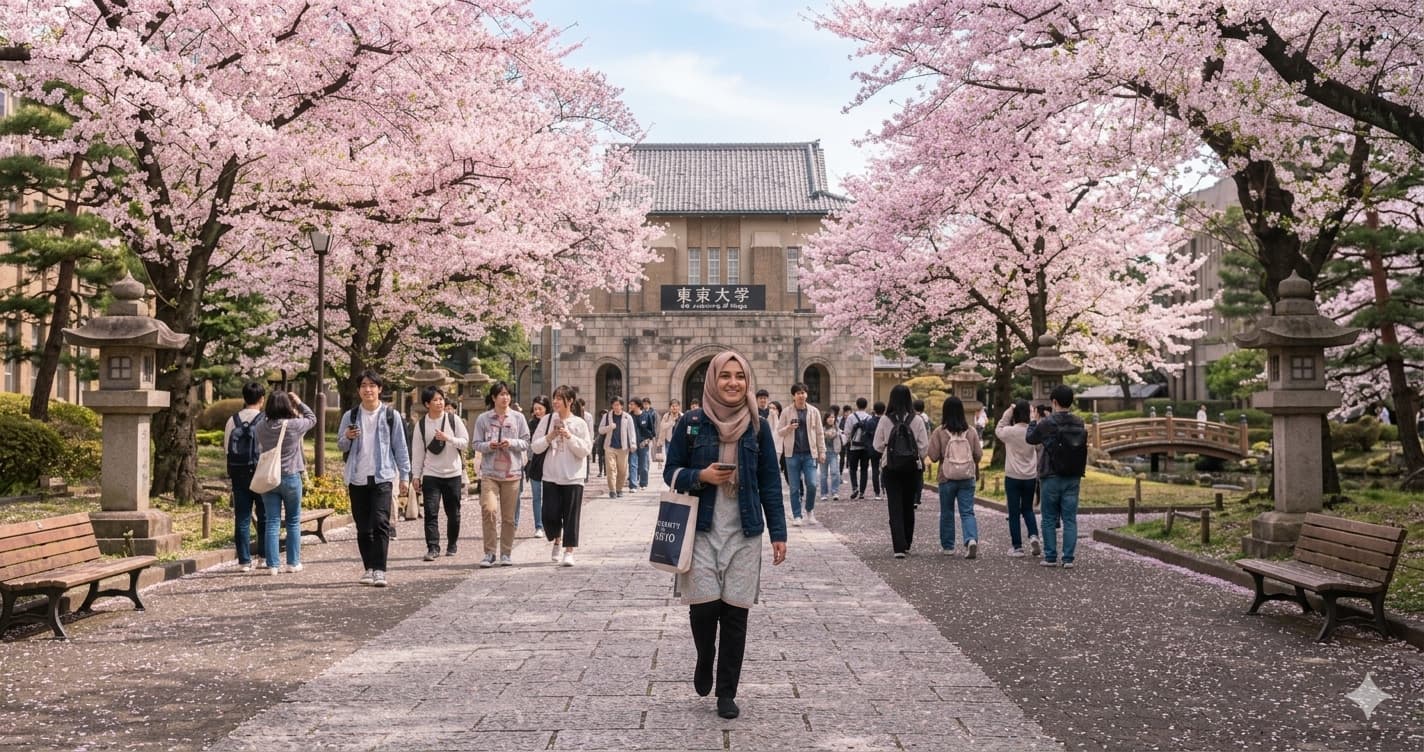
Are you a Pakistani student dreaming of studying at world-class universities in Japan? You are not alone. In the 2025–2026 academic year, over 4,000 Pakistani students were enrolled in Japanese institutions — and that number is growing rapidly every year.
Japan is the world’s third-largest economy, a global leader in technology, robotics, and automotive engineering, and home to some of Asia’s highest-ranked universities. For Pakistani students, Japan offers a unique combination of affordable tuition, generous scholarships like MEXT, part-time work opportunities, and post-study career pathways — all in one of the safest countries on earth.
At Career Connection Consulting, we have helped hundreds of Pakistani students successfully navigate the admission, scholarship, and visa process for Japan. In this comprehensive, up-to-date guide (verified as of October 2026), we cover everything you need to know — from eligibility requirements and costs to step-by-step visa procedures and life in Japan as a Muslim student.
📑 Table of Contents
- Why Study in Japan from Pakistan?
- Study in Japan from Pakistan Requirements (2026)
- Step-by-Step Process to Study in Japan
- Japan Study Visa Requirements for Pakistani Students
- Study in Japan from Pakistan Fees & Living Costs (2026)
- Scholarships for Pakistani Students (MEXT, JASSO, PhD & Free Education)
- Top Universities in Japan for Pakistani Students
- Best Courses, IT Universities & Degrees to Study in Japan
- Japanese Language Courses in Japan for Pakistani Students
- Vocational Schools & Short Courses in Japan
- Study & Work in Japan on a Student Visa
- Post-Study Work & Career Opportunities
- Is Japan Friendly to Muslims?
- Why Choose Career Connection Consulting?
- FAQs About Studying in Japan from Pakistan
1. Why Study in Japan from Pakistan?
Japan and Pakistan have enjoyed over 70 years of diplomatic relations. The Japanese government actively encourages Pakistani students through bilateral scholarship programs, cultural exchanges, and educational partnerships. Here are the top reasons why Japan is an excellent study destination for Pakistani students in 2026:
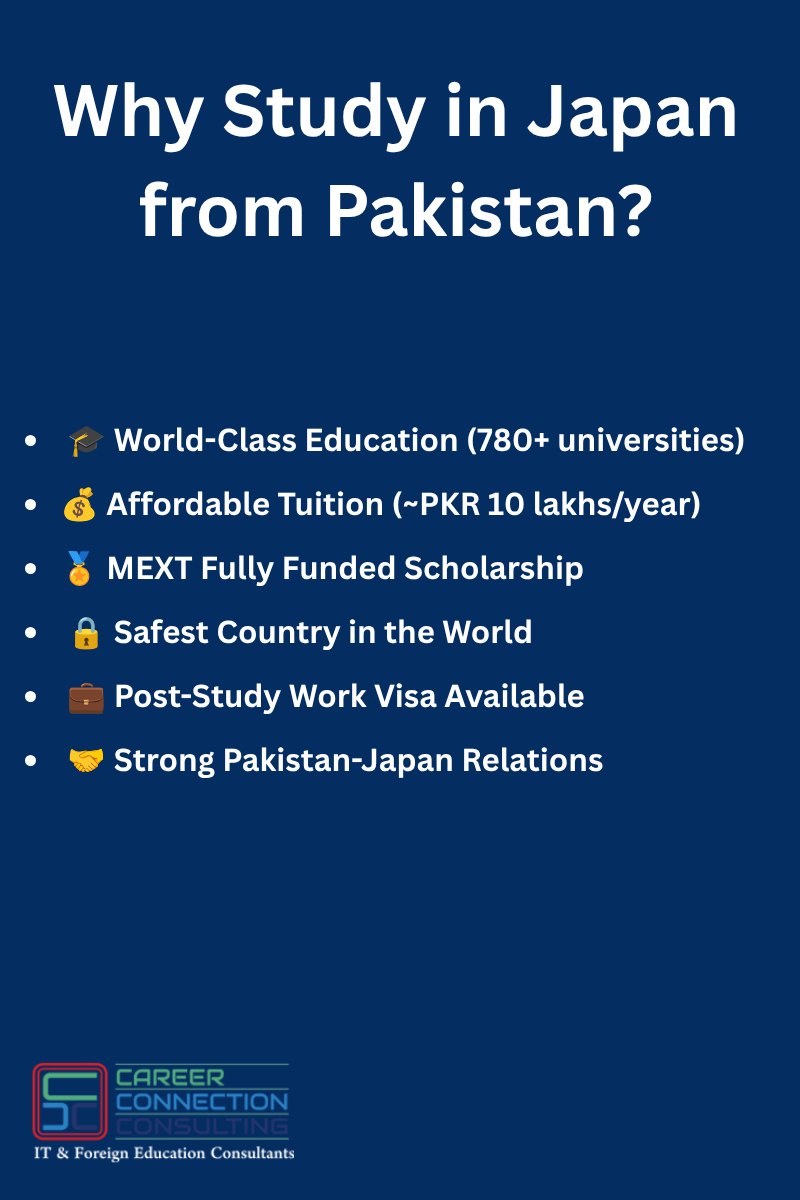
🎓 World-Class Education
Japan is home to over 780 universities, including globally ranked institutions like the University of Tokyo (QS World Rank #32 in 2026), Kyoto University (#65), and Osaka University (#86). Japanese degrees are recognized and respected worldwide.
💰 Affordable Tuition Compared to Western Countries
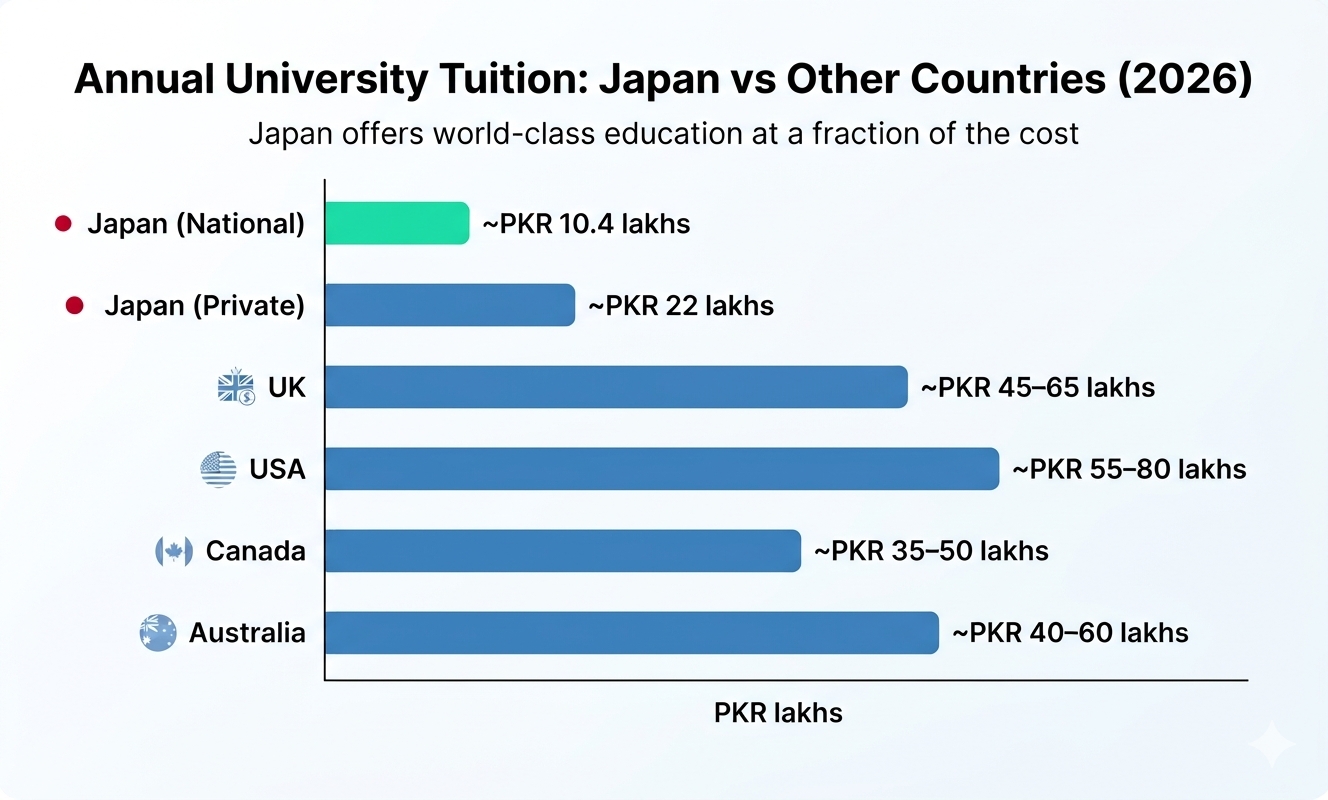
Annual tuition at Japanese national universities is approximately 535,800 JPY (~PKR 10–11 lakhs as of 2026 exchange rates) — significantly lower than universities in the UK, USA, Canada, or Australia. Many programs also offer tuition waivers of 25%–100%.
🏅 Generous Scholarships
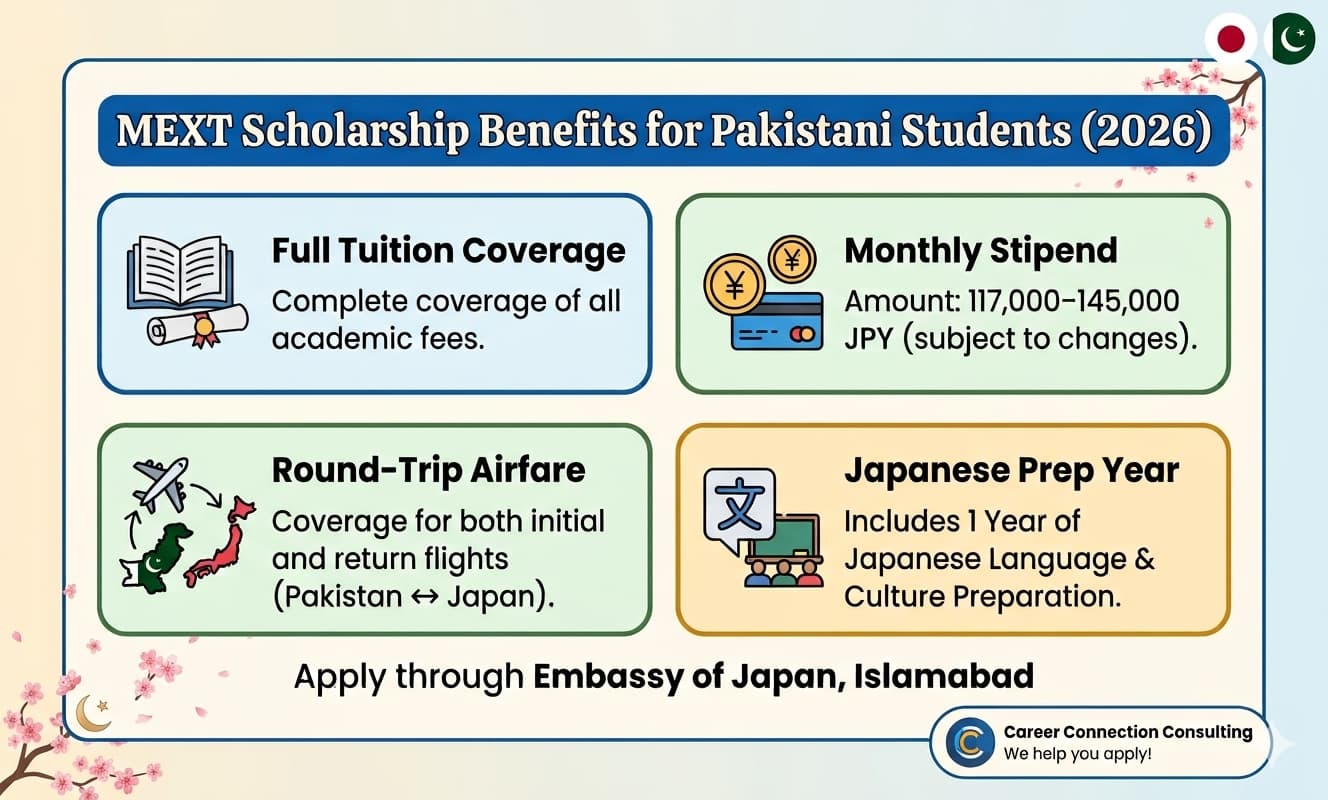
The MEXT (Monbukagakusho) Scholarship is one of the most generous fully funded scholarships in the world, covering tuition, living expenses (up to 145,000 JPY/month in 2026), airfare, and more.
🔒 Safety & Quality of Life
Japan consistently ranks among the top 10 safest countries in the world (Global Peace Index 2026). Its public transportation system is unmatched, healthcare is excellent, and the quality of life is extremely high.
💼 Post-Study Work Opportunities
Japan’s aging population has created a massive demand for skilled workers — the government aims to attract 400,000+ international workers by 2027. International graduates can convert their student visa to a work visa after completing studies.
🤝 Strong Pakistan-Japan Relations
Pakistan is one of Japan’s priority partner countries. The Japanese Embassy in Islamabad and Consulate General in Karachi actively promote study opportunities, and the 2026 MEXT cycle saw a record number of Pakistani applicants.
2. Study in Japan from Pakistan Requirements (2026 Updated)
Before applying to a Japanese university, you must meet specific academic, language, and financial requirements. Here are the latest requirements valid for the 2026–2027 academic year:
📚 Academic Requirements
| Program Level | Minimum Education | GPA Requirement |
|---|---|---|
| Undergraduate (Bachelor’s) | 12 years of education (HSSC / A-Levels) | Minimum 2.5 GPA (3.0+ preferred) |
| Master’s Degree | 16 years of education (Bachelor’s degree) | Minimum 3.0 GPA (3.5+ for MEXT) |
| PhD / Doctoral | 18 years of education (Master’s degree) | Minimum 3.0 GPA |
| Language School | 12 years of education (HSSC) | No strict minimum |
🌐 Language Requirements
Is IELTS required for Japan? — This is one of the most common questions we receive at Career Connection Consulting. The answer: it depends on the program type.
| Program Type | Language Required | Accepted Tests (2026) |
|---|---|---|
| Japanese-taught programs | Japanese (JLPT N2 or higher) | JLPT, EJU, J-CAT |
| English-taught programs (SGU/G30) | English | IELTS 6.0+, TOEFL iBT 80+, Duolingo 105+, PTE 55+ |
| Language schools | Basic Japanese | JLPT N5, NAT-TEST, or 150+ hours certificate |
| MEXT Scholarship programs | Varies by category | IELTS/TOEFL recommended (not always mandatory) |
Japan has over 60 English-taught degree programs under the SGU (Super Global University) and G30 initiatives as of 2026. For these programs, IELTS or TOEFL is accepted — and some universities even waive the test if your prior education was conducted in English.
📅 Age Requirements
- MEXT Undergraduate: Under 25 years of age at the time of arrival in Japan
- MEXT Research (Master’s/PhD): Under 35 years of age
- General Student Visa: No strict upper age limit, but applicants above 30 may need to justify gaps in education
- Language Schools: Generally prefer applicants under 30; some accept up to 35
3. Step-by-Step Process to Study in Japan from Pakistan
The process of studying in Japan may seem complex, but when you break it down, it becomes manageable. Here is the exact 2026 process our team at Career Connection Consulting follows with every student:
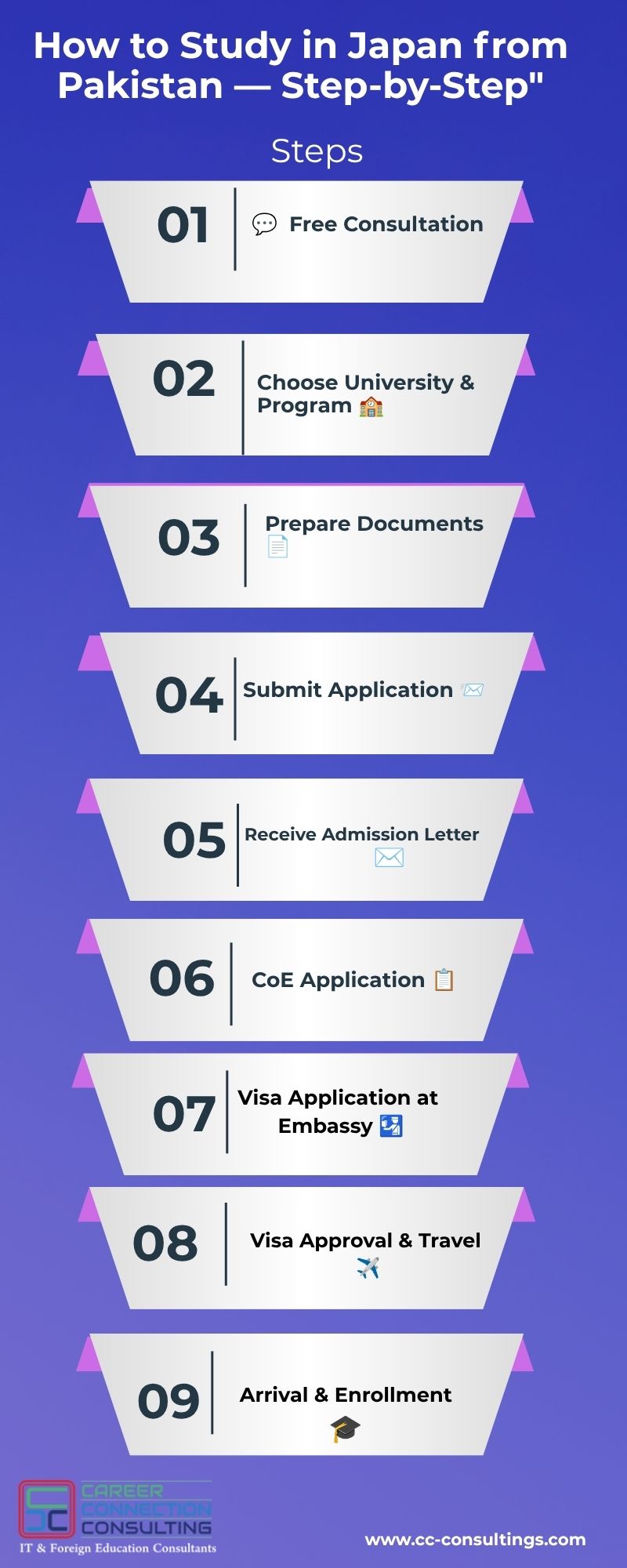
Step 1: Free Consultation with Career Connection Consulting
Contact our team for a free initial assessment. We evaluate your academic background, budget, career goals, and preferred study programs to create a personalized Japan study plan. Available via WhatsApp, phone, or in-person.
Step 2: Choose a University and Program
Select from 60+ English-taught or Japanese-taught programs across 780+ universities. We help you shortlist 3–5 universities based on your academic profile, scholarship eligibility, and career goals.
Step 3: Prepare Your Documents
Typical documents required for the 2026–2027 intake include:
- Academic transcripts and certificates (attested by IBCC if needed)
- Valid Pakistani passport (6+ months validity remaining)
- Passport-sized photographs (4.5cm × 4.5cm, white background)
- Statement of Purpose (SOP) / Study Plan / Research Proposal
- 2–3 Letters of Recommendation from professors or employers
- IELTS/TOEFL or JLPT score report
- Financial documents (bank statements of the last 6 months)
- Japanese language learning certificate (if applicable)
- Medical fitness certificate
Step 4: Submit University Application
Applications are submitted online or by mail depending on the university. Key deadlines for 2026–2027: October–January for April 2027 intake and April–July for October 2027 intake. Some language schools have rolling admissions (January, April, July, October intakes).
Step 5: Receive Admission / Acceptance Letter
Once accepted, the university or language school sends you an official admission letter via email and/or mail. This document is essential for the next step.
Step 6: Certificate of Eligibility (CoE) Application
Your university or language school applies for a Certificate of Eligibility (CoE) on your behalf at Japan’s Immigration Services Agency. This is the most critical document in the process. Processing takes 1–3 months (as of 2026, some cases are processed faster via online systems).
Step 7: Receive CoE & Apply for Student Visa
Once you receive the original CoE (mailed from Japan to Pakistan), submit your student visa application at:
- Embassy of Japan in Islamabad — for applicants from Punjab, KPK, Balochistan, Gilgit-Baltistan, AJK, and Islamabad Capital Territory
- Consulate General of Japan in Karachi — for applicants from Sindh province
Step 8: Visa Approval & Travel to Japan
Student visa processing takes approximately 5–7 working days at the embassy/consulate. Once approved, book your flight (PIA, Emirates, Qatar Airways, and Turkish Airlines operate popular routes to Japan) and prepare for departure!
Step 9: Arrival in Japan & Enrollment
Upon arrival at Narita, Haneda, Kansai, or other airports, go through immigration, receive your Residence Card, and (optionally) apply for part-time work permission at the airport. Then register at your local ward office, open a Japanese bank account, get a phone number, and complete enrollment at your institution. Career Connection Consulting provides post-arrival support for all our students.
4. Japan Study Visa Requirements for Pakistani Students (2026)
Can I get a study visa for Japan if I am from Pakistan? — Absolutely yes. Pakistan is an eligible country, and Japan issues thousands of student visas to Pakistani applicants every year. The key is the Certificate of Eligibility (CoE) — once you have this, the visa approval rate is extremely high (estimated 95%+ as of 2026).
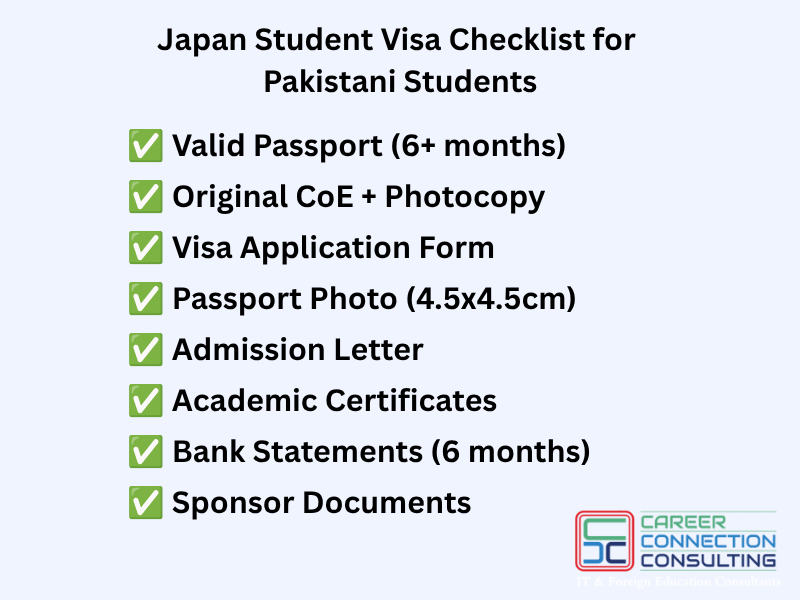
Required Documents for Japan Student Visa (2026)
- Valid Pakistani Passport (at least 6 months validity remaining, with blank pages)
- Original Certificate of Eligibility (CoE) + one clear photocopy
- Visa Application Form (downloadable from the Japanese Embassy Pakistan website)
- Passport-sized Photograph (4.5cm × 4.5cm, white background, taken within last 6 months)
- Letter of Admission from the Japanese institution
- Academic Certificates & Transcripts (original + attested copies)
- Financial Evidence (bank statements of the last 6 months showing sufficient funds)
- Sponsor Documents — if a family member is sponsoring: employment letter, salary slips, income tax returns, CNIC copy, undertaking letter, and relationship proof
- IBCC Equivalence Certificate (for students with Pakistani board qualifications)
How Much Bank Balance Is Required for a Japan Visa in 2026?
There is no officially published minimum bank balance amount by the Japanese Embassy. However, based on our extensive experience processing hundreds of cases at Career Connection Consulting, we recommend:
Is a Japan Student Visa Easy to Get from Pakistan?
Compared to Schengen, US, UK, or Canadian visas, the Japan student visa process is relatively straightforward. The most challenging part is obtaining the Certificate of Eligibility — this is where most applicants face delays or rejections due to incomplete or inconsistent documentation. Once you have the CoE, the visa at the embassy is almost guaranteed.
Working with an experienced consultant like Career Connection Consulting significantly reduces the risk of CoE rejection by ensuring your documentation is complete, consistent, and professionally prepared.
How Long Is a Japan Student Visa Valid?
- Language School: 1 year 3 months (renewable up to 2 years total stay)
- Undergraduate: 1 year 3 months or 2 years 3 months (renewable for the full duration of the program)
- Master’s/PhD: 2 years (renewable until completion)
- MEXT Scholars: Visa validity matches the scholarship period
5. Study in Japan from Pakistan Fees & Living Costs (2026 Updated)
How much does it cost for a Pakistani student to study in Japan? — Here is a detailed breakdown with PKR conversions based on the October 2026 exchange rate (1 JPY ≈ PKR 1.95):
Tuition Fees (2026–2027 Academic Year)
| Institution Type | Annual Tuition (JPY) | Annual Tuition (PKR) |
|---|---|---|
| National University | 535,800 | ~PKR 10.4 lakhs |
| Public University | 535,800 – 620,000 | ~PKR 10.4–12.1 lakhs |
| Private University | 800,000 – 1,500,000 | ~PKR 15.6–29.3 lakhs |
| Japanese Language School | 650,000 – 950,000 | ~PKR 12.7–18.5 lakhs |
| Vocational School (Senmon Gakkou) | 600,000 – 1,200,000 | ~PKR 11.7–23.4 lakhs |
Note: Many national and public universities offer tuition waivers of 25%–100% for international students demonstrating financial need. We help our students at Career Connection Consulting identify and apply for these waivers as part of our service.
Monthly Living Costs in Japan (2026)
| Expense | Tokyo (JPY/month) | Other Cities (JPY/month) | PKR Equivalent |
|---|---|---|---|
| Rent (shared apartment / dormitory) | 40,000–75,000 | 25,000–45,000 | PKR 49,000–146,000 |
| Food & Groceries | 30,000–45,000 | 25,000–35,000 | PKR 49,000–88,000 |
| Transportation | 10,000–15,000 | 5,000–10,000 | PKR 10,000–29,000 |
| Utilities (electricity, gas, water) | 8,000–12,000 | 6,000–10,000 | PKR 12,000–23,000 |
| Phone & Internet | 3,000–5,000 | 2,000–4,000 | PKR 4,000–10,000 |
| National Health Insurance (NHI) | 1,500–2,500 | 1,500–2,500 | PKR 3,000–5,000 |
| 📊 Total Monthly | 100,000–155,000 | 70,000–105,000 | PKR 1.37–3.02 lakhs |
Total First-Year Cost Estimate (2026)
| Scenario | Total First Year (JPY) | Total First Year (PKR) |
|---|---|---|
| National University (budget living outside Tokyo) | ~1,375,800 | ~PKR 26.8 lakhs |
| National University (Tokyo living) | ~1,935,800 | ~PKR 37.7 lakhs |
| Private University (Tokyo) | ~2,700,000+ | ~PKR 52.7 lakhs+ |
| MEXT Scholar (any university) | 0 (fully funded) | PKR 0 🎉 |
🎓 Fully Funded PhD Scholarships in Japan for Pakistani Students (2026)
Japan is an excellent destination for doctoral research, especially in STEM fields. Here are the best fully funded PhD scholarship options available to Pakistani researchers:
| PhD Scholarship | Monthly Stipend (JPY) | Duration | Coverage |
|---|---|---|---|
| MEXT Research Scholarship (PhD) | 145,000 | 3–4 years | Full tuition + stipend + airfare |
| JSPS Research Fellowship (DC1/DC2) | 200,000 | 2–3 years | Stipend + research grant (up to 1.5M JPY/year) |
| University-Specific PhD Fellowships | 100,000–180,000 | 3 years | Tuition waiver + stipend (varies by university) |
| JICA Long-Term Training | Varies | 2–4 years | Full coverage for government employees |
| Professor’s Research Fund (RA Position) | 80,000–150,000 | Duration of project | Paid from professor’s research grant |
How to find a PhD supervisor in Japan:
- Search professor profiles on university websites or Google Scholar
- Read 2–3 of their recent papers to understand their research
- Write a professional email introducing yourself, your research interest, and asking about PhD openings
- Attach your CV, transcripts, and a 1-page research proposal
- If the professor agrees, they can guide you through the MEXT or direct admission process
At Career Connection Consulting, we help PhD applicants identify suitable supervisors, write compelling research proposals, and navigate the MEXT application process from start to finish.
6. Scholarships for Pakistani Students in Japan (2026–2027)
How can I get a full scholarship to study in Japan? — Japan offers some of the most generous scholarships in the world, and Pakistani students are highly eligible. Here are the major scholarship options for the 2026–2027 cycle:
🏆 MEXT Scholarship (Monbukagakusho) — Fully Funded by Japanese Government
The MEXT Scholarship is the flagship scholarship offered by the Japanese government. It is one of the most comprehensive fully funded scholarships available anywhere in the world for Pakistani students.
| MEXT Category | Monthly Stipend (JPY) — 2026 | Duration | Coverage |
|---|---|---|---|
| Research (Master’s/PhD) | 143,000–145,000 | 2–5 years | Full tuition + stipend + airfare |
| Undergraduate | 117,000 | 5 years (inc. 1 year Japanese language prep) | Full tuition + stipend + airfare |
| College of Technology | 117,000 | 4–5 years | Full tuition + stipend + airfare |
| Specialized Training | 117,000 | 3 years | Full tuition + stipend + airfare |
MEXT 2027 Application Timeline for Pakistani Students:
- April 2026: Embassy of Japan in Islamabad announces the 2027 MEXT cycle
- May–June 2026: Application submission deadline (Research: ~late May; Undergraduate: ~early June)
- June–July 2026: Written examination & interviews at the Embassy
- August–November 2026: University placement & final selection in Tokyo
- January–February 2027: Final results announced
- April 2027 or October 2027: Arrival in Japan
👉 Read our detailed MEXT guide: MEXT Japan Scholarships for Pakistani Students — Fully Funded Guide
🆓 Can You Study in Japan for Free? (Complete Guide to Free Education)
Is free education in Japan possible for Pakistani students? — Yes! While Japan doesn’t have completely “free” public universities like Germany or Norway, there are multiple legitimate ways to study in Japan for free or at near-zero cost:
| Method | Tuition Cost | Living Cost Covered? | How to Get It |
|---|---|---|---|
| MEXT Scholarship (Fully Funded) | 100% FREE | ✅ Yes (stipend + airfare) | Apply via Embassy of Japan in Islamabad |
| National University + 100% Tuition Waiver | 100% FREE | ❌ No (use part-time work) | Apply to university financial aid office after enrollment |
| National University + 50% Waiver + JASSO | ~267,900 JPY/year (~PKR 5.2 lakhs) | Partially (48,000 JPY/month stipend) | Apply to both university and JASSO |
| ADB-JSP Scholarship (Fully Funded) | 100% FREE | ✅ Yes (full coverage) | Apply through partner universities (Master’s only) |
| University-Specific Full Scholarships | 100% FREE | Varies | Check individual university websites or ask CCC |
👉 The MEXT Scholarship remains the best and most reliable way to study in Japan completely free. Read our detailed guide: MEXT Japan Scholarships for Pakistani Students — Fully Funded
📋 Other Scholarships for Pakistani Students (2026–2027)
| Scholarship | Type | Amount (2026) | Eligibility |
|---|---|---|---|
| JASSO Honors Scholarship | Partial | 48,000 JPY/month | Privately financed students with excellent grades |
| JASSO Tuition Reduction | Partial | 30% tuition reduction | Based on financial need |
| ADB-Japan Scholarship (ADB-JSP) | Full | Full tuition + living + travel | Master’s students from ADB developing member countries (Pakistan eligible) |
| Rotary Yoneyama Memorial Scholarship | Partial | 100,000–140,000 JPY/month | Students already enrolled in Japanese universities |
| JICA ABE Initiative | Full | Full tuition + living + internship | Young professionals from developing countries |
| University-Specific Scholarships | Varies | 25%–100% tuition waiver | Varies by university — ask us for details |
📌 What is JASSO? (Japan Student Services Organization)
JASSO (Japan Student Services Organization) is a government agency that supports international students in Japan through scholarships, housing assistance, and information services. JASSO manages the official “Study in Japan” portal and administers the EJU (Examination for Japanese University Admission) used by many universities for entrance screening.
Key JASSO programs for Pakistani students:
- JASSO Honors Scholarship: 48,000 JPY/month (~PKR 93,600) for privately funded students with excellent academic performance
- JASSO Tuition Reduction: 30% reduction in tuition at participating universities
- JASSO Study in Japan Fair: Annual virtual and in-person events where Pakistani students can meet Japanese university representatives directly
- JASSO Student Guide: Free comprehensive guidebook covering all aspects of studying in Japan — available on the Study in Japan website
Career Connection Consulting tip: After receiving admission to a Japanese university, immediately ask your university’s international office about JASSO scholarship nomination. Many universities can nominate you directly — you don’t need to apply separately. We guide all our students through this process.
7. Top Universities in Japan for Pakistani Students (2026 Rankings)
Japan’s top universities offer world-class research facilities, English-taught programs, and strong industry connections. Here are the best options for Pakistani students based on 2026 QS World University Rankings:
| University | QS Rank 2026 | Type | English Programs | Location |
|---|---|---|---|---|
| University of Tokyo | #32 | National | ✅ PEAK, GSP, GSGP | Tokyo |
| Kyoto University | #65 | National | ✅ Multiple graduate programs | Kyoto |
| Osaka University | #86 | National | ✅ FrontierLab, iGCORE | Osaka |
| Tohoku University | #107 | National | ✅ FGL, IGPAS, IMAC-U | Sendai |
| Tokyo Institute of Technology (Tokyo Tech) | #120 | National | ✅ GSEP, Engineering programs | Tokyo |
| Nagoya University | #152 | National | ✅ G30 programs | Nagoya |
| Kyushu University | #167 | National | ✅ G30, IUPE | Fukuoka |
| Hokkaido University | #177 | National | ✅ Modern Japanese Studies, ISP | Sapporo |
| Waseda University | #181 | Private | ✅ SILS, Political Science, Engineering | Tokyo |
| Keio University | #188 | Private | ✅ PEARL, GIGA | Tokyo |
| University of Tsukuba | #355 | National | ✅ Multiple English degree programs | Tsukuba (near Tokyo) |
Can’t decide which university is right for you? Our team at Career Connection Consulting will match you with the best universities based on your academic profile, budget, career goals, and preferred location in Japan.
8. Best Courses & Degrees to Study in Japan (2026 Demand Analysis)
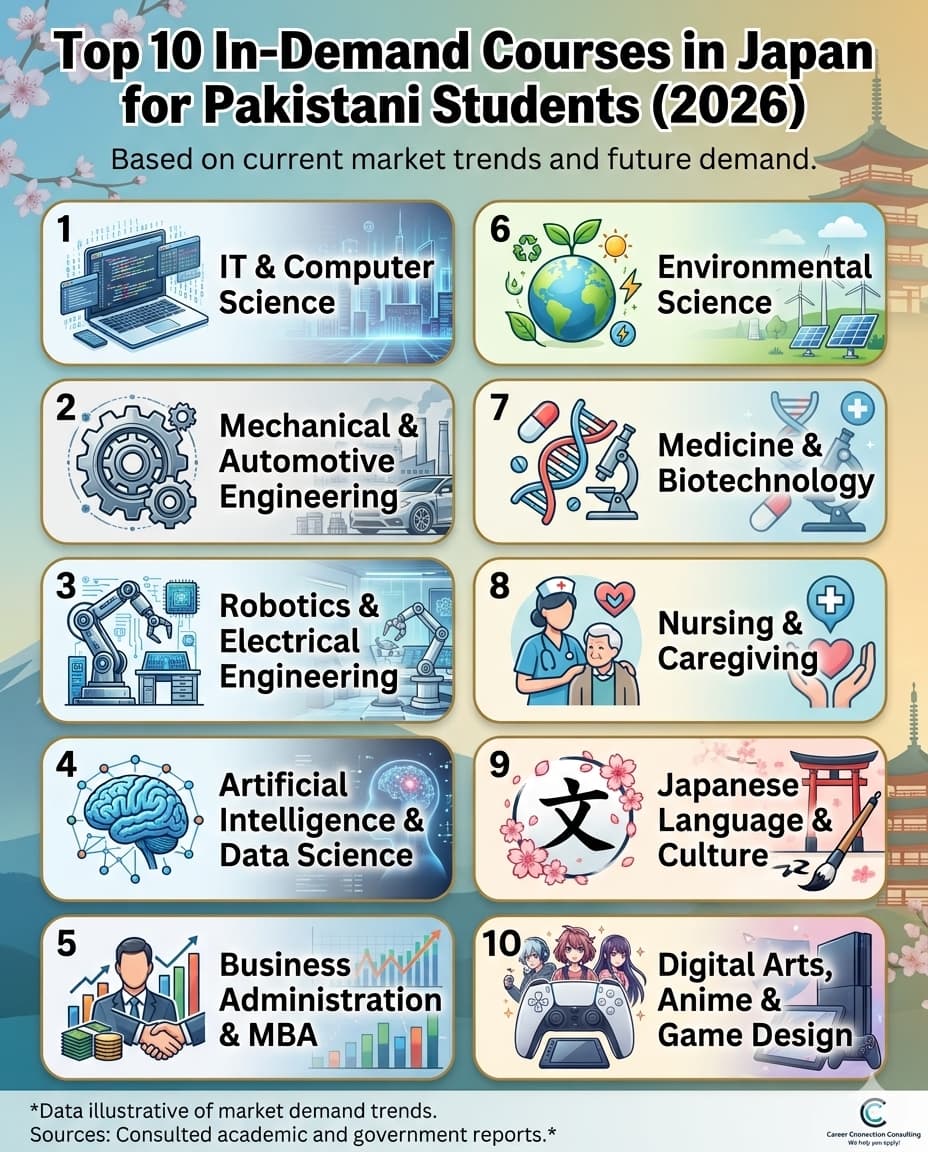
Which course is best in Japan? and What degree is most needed in Japan? — The answer depends on Japan’s current labor market demands. As of 2026, Japan’s Ministry of Economy, Trade and Industry (METI) has identified critical workforce shortages in the following fields:
🥇 1. Information Technology & Computer Science
Japan faces a severe IT talent shortage — the government estimates 790,000+ IT professionals will be needed by 2030. Pakistani students with CS/IT backgrounds are in extremely high demand after graduation. English-taught IT programs are widely available.
🥈 2. Mechanical & Automotive Engineering
Home to Toyota, Honda, Nissan, Suzuki, and Subaru — Japan’s automotive industry offers unmatched career opportunities. The shift to electric vehicles (EVs) has created even more demand for engineers.
🥉 3. Electrical Engineering & Robotics
Japan is the global leader in robotics and automation. Universities like Tohoku, Osaka, and Tokyo Tech have world-renowned robotics research labs with cutting-edge facilities.
4. Artificial Intelligence & Data Science
Japan’s “Society 5.0” initiative is driving massive investment in AI. Multiple English-taught AI and data science programs have launched in 2025–2026.
5. Business Administration & MBA
English-taught MBA programs at Waseda, Hitotsubashi, and Keio provide excellent networking with Japanese corporations and startups.
6. Environmental Science & Sustainability
Japan’s focus on sustainability, disaster management, and green energy creates unique opportunities in environmental engineering and climate science.
7. Medicine, Biotechnology & Pharmaceutical Sciences
Japan’s pharmaceutical industry is the third largest globally. Research opportunities in biotech, drug development, and medical sciences are abundant.
8. Nursing & Caregiving
Japan’s rapidly aging population (29%+ over 65 as of 2026) has created urgent demand for healthcare workers. Special visa pathways and training programs exist for nursing graduates from Pakistan.
9. Japanese Language & Culture Studies
For students interested in translation, interpretation, tourism, or diplomacy, studying Japanese language and culture opens unique career paths in both Japan and Pakistan.
10. Digital Arts, Animation & Game Design
Japan is the birthplace of anime and gaming (industry worth $25+ billion). Specialized schools and universities offer world-class programs in digital entertainment.
🏫 Best IT & Engineering Universities in Japan for Pakistani Students
Since IT and engineering are the most in-demand courses in Japan, here are the top universities specifically known for these programs — many offer English-taught bachelor’s and master’s degrees:
| University | IT/Engineering Program | Language | Annual Tuition (JPY) |
|---|---|---|---|
| Tokyo Institute of Technology (Tokyo Tech) | Computer Science, Electrical Engineering, Mechanical Engineering | English + Japanese | 535,800 |
| University of Tokyo | Information Science, Systems Engineering, AI | English (PEAK program) | 535,800 |
| Osaka University | Engineering Science, Information Technology | English (some programs) | 535,800 |
| Tohoku University | Materials Engineering, Robotics, IT | English (IMAC-U, FGL) | 535,800 |
| Nagoya University | Automotive Engineering, IT, Physics | English (G30) | 535,800 |
| Ritsumeikan Asia Pacific University (APU) | IT, International Management | 100% English | ~1,400,000 (private) |
| University of Tsukuba | Computer Science, Engineering Mechanics | English programs available | 535,800 |
📋 Other Popular Courses in Japan for Pakistani Students
| Course Category | Specific Programs | Available in English? | Career Demand in Japan |
|---|---|---|---|
| Civil Engineering | Infrastructure, Earthquake Engineering, Urban Planning | ✅ At national universities | ⭐⭐⭐⭐ (High) |
| Agriculture & Food Science | Agricultural Engineering, Food Technology, Fisheries | ✅ At Hokkaido, Kyushu, Tsukuba | ⭐⭐⭐ (Moderate) |
| International Business & Management | MBA, International Management, Marketing | ✅ At Waseda, Keio, APU, Hitotsubashi | ⭐⭐⭐⭐ (High) |
| Medicine & MBBS | Medical Sciences, Public Health, Biomedical Engineering | ⚠️ Limited (mostly Japanese-taught for clinical medicine) | ⭐⭐⭐⭐⭐ (Very High) |
| 1-Year Certificate Courses | IT Certificates, Hospitality, Tourism, Caregiving | ⚠️ Mostly Japanese | ⭐⭐⭐⭐ (High for caregiving) |
Japanese Language Courses in Japan for Pakistani Students (2026)
One of the most popular pathways for Pakistani students to enter Japan is through a Japanese language school. These schools teach you Japanese from beginner level (JLPT N5) to advanced (N1) and serve as a stepping stone to university admission, vocational training, or direct employment in Japan.
Why Study Japanese in Japan?
- Immersive environment — learn Japanese 10x faster by living in Japan and practicing daily
- Gateway to university — many students use language school as a bridge to undergraduate or graduate programs
- Part-time work eligible — language school students can work 28 hours/week
- Student visa — language schools sponsor your Certificate of Eligibility (CoE) for a student visa
- Scholarship opportunity — study Japanese in Japan on a scholarship through MEXT, JASSO, or school-specific programs
Types of Japanese Language Programs
| Program Type | Duration | Cost (JPY) | Cost (PKR) | Visa Eligible? |
|---|---|---|---|---|
| Long-term course (1–2 years) | 12–24 months | 650,000–950,000/year | ~PKR 12.7–18.5 lakhs/year | ✅ Yes (Student Visa) |
| Short-term course (1–3 months) | 4–12 weeks | 150,000–350,000 | ~PKR 2.9–6.8 lakhs | ❌ Tourist visa only |
| Intensive course (6 months) | 6 months | 350,000–500,000 | ~PKR 6.8–9.8 lakhs | ✅ Yes (some schools) |
| University preparatory course | 12–18 months | 700,000–1,000,000 | ~PKR 13.7–19.5 lakhs | ✅ Yes (Student Visa) |
Top Cities for Japanese Language Study
| City | Best For | Living Cost | Part-Time Jobs |
|---|---|---|---|
| Tokyo | Most language schools, biggest Pakistani community, maximum job opportunities | High | ⭐⭐⭐⭐⭐ |
| Osaka | Lower cost than Tokyo, vibrant culture, halal food availability | Medium | ⭐⭐⭐⭐ |
| Kyoto | Traditional Japanese culture, smaller class sizes, peaceful environment | Medium | ⭐⭐⭐ |
| Fukuoka | Lowest living costs among major cities, growing international community | Low | ⭐⭐⭐ |
| Nagoya | Automotive industry hub, good part-time jobs at Toyota-related factories | Medium-Low | ⭐⭐⭐⭐ |
Japanese Language Scholarship for Pakistani Students
- MEXT Japanese Language & Culture Scholarship — 1-year fully funded program for students already enrolled in a university in Pakistan (covers travel + stipend + tuition)
- JASSO Study in Japan Scholarship — 48,000 JPY/month for privately funded language students with excellent attendance
- School-specific scholarships — Many language schools offer 20%–50% tuition discounts for students with good grades or early enrollment
Vocational Schools & Short Courses in Japan for Pakistani Students
Not everyone wants a 4-year university degree. Japan’s vocational schools (専門学校 / Senmon Gakkou) offer practical, career-focused training programs that typically last 1–2 years and lead directly to employment in Japan.
What Are Vocational Schools in Japan?
Senmon Gakkou are specialized training institutions recognized by the Japanese Ministry of Education. Graduates receive a “Diploma” or “Advanced Diploma” that qualifies them for a work visa in Japan — similar to a degree from a university.
Popular Vocational School Courses for Pakistani Students
| Course | Duration | Annual Fee (JPY) | Annual Fee (PKR) | Work Visa Eligible? |
|---|---|---|---|---|
| IT & Web Development | 2 years | 800,000–1,200,000 | ~PKR 15.6–23.4 lakhs | ✅ Yes |
| Automotive Mechanics | 2 years | 900,000–1,300,000 | ~PKR 17.6–25.4 lakhs | ✅ Yes |
| Hospitality & Hotel Management | 1–2 years | 700,000–1,100,000 | ~PKR 13.7–21.5 lakhs | ✅ Yes |
| Caregiving & Welfare (介護) | 2 years | 600,000–900,000 | ~PKR 11.7–17.6 lakhs | ✅ Yes (special visa category) |
| Animation & Game Design | 2 years | 1,000,000–1,500,000 | ~PKR 19.5–29.3 lakhs | ✅ Yes |
| Business & International Trade | 2 years | 700,000–1,000,000 | ~PKR 13.7–19.5 lakhs | ✅ Yes |
📋 Study & Work in Japan: What Pakistani Students Need to Know
Japan’s student visa legally allows you to study AND work simultaneously. Unlike many countries that restrict or prohibit student employment, Japan actively encourages international students to gain work experience during their studies. Here’s the key framework:
- ✅ 28 hours/week part-time work during academic semesters
- ✅ 40 hours/week during official school vacations
- ✅ Average earnings: PKR 1.66–2.34 lakhs/month from part-time work alone
- ✅ No additional visa needed — just apply for work permission at the airport or immigration office
- ✅ Career pathway: Part-time experience often leads directly to full-time job offers after graduation
Many Pakistani students at Career Connection Consulting cover their entire living expenses — and sometimes even part of their tuition — through part-time work while studying. This effectively makes studying in Japan a self-funding experience.
9. Working in Japan on a Student Visa (2026 Rules)
Can I work in Japan with a student visa? — Yes! Japan allows international students to work part-time, making it one of the most student-friendly countries for earning while studying.
Part-Time Work Rules (2026)
| Period | Maximum Hours | Notes |
|---|---|---|
| During academic term | 28 hours/week | Strictly enforced — exceeding can lead to visa revocation |
| During vacations (summer/winter/spring break) | 40 hours/week | Full-time permitted during official school holidays |
Important: You must apply for the “Permission to Engage in Activity Other Than That Permitted” (資格外活動許可 / shikaku-gai katsudou kyoka) at the immigration office. Pro tip: You can request this at the airport immigration counter upon your very first arrival in Japan — just check the box on your landing card.
How Much Can a Student Earn in Japan? (2026 Wages)
| Metric | Amount (JPY) | Amount (PKR) |
|---|---|---|
| Minimum hourly wage (national average 2026) | 1,054 JPY | ~PKR 2,055 |
| Minimum hourly wage (Tokyo 2026) | 1,163 JPY | ~PKR 2,268 |
| Average student part-time wage | 1,100–1,500 JPY/hr | ~PKR 2,145–2,925/hr |
| Monthly income (28 hrs/week) | 85,000–120,000 JPY | ~PKR 1.66–2.34 lakhs |
| Monthly income during vacation (40 hrs/week) | 120,000–180,000 JPY | ~PKR 2.34–3.51 lakhs |
Best Part-Time Jobs for Pakistani Students in Japan (2026)
- Convenience Store (Konbini) — 7-Eleven, Lawson, FamilyMart (most popular, flexible shifts)
- Restaurant / Fast Food — Kitchen staff, waiter (basic Japanese needed)
- Factory / Warehouse Work — Sorting, packaging, logistics (night shifts = higher pay: 25%+ premium)
- Food Delivery — Uber Eats, Wolt, Demae-can (flexible schedule, cycle or scooter)
- English / Urdu Tutoring — Private lessons or at language schools (high hourly rate)
- IT Freelancing — Web development, app development, graphic design (highest earning potential: 2,000–5,000 JPY/hr)
- Hotel / Tourism — Front desk, cleaning, tour assistance (in tourist areas)
- Translation / Interpretation — Urdu-Japanese, English-Japanese (growing demand)
10. Post-Study Work & Career Opportunities in Japan (2026)
One of the biggest advantages of studying in Japan is the excellent post-study career pathway. The Japanese government has set a goal of retaining 60% of international graduates in the workforce by 2027.
Can I Convert My Student Visa to a Work Visa?
Yes! If you receive a job offer from a Japanese employer before or after graduation, you can apply for a Change of Status of Residence from “Student” (留学) to a work visa category:
- Engineer / Specialist in Humanities / International Services (技術・人文知識・国際業務) — most common for university graduates
- Highly Skilled Professional (高度専門職) — points-based system with fast-track to permanent residency (as few as 1 year!)
- Specified Skilled Worker (特定技能) — for technical/vocational graduates in 16 shortage industries (updated in 2024 to include more sectors)
Job Hunting Visa (Designated Activities)
If you haven’t found a job by graduation, Japan offers a 6-month to 1-year “Designated Activities” (特定活動) visa specifically for job hunting. During this period, you can:
- Attend job interviews and career fairs
- Work part-time (28 hours/week) to support yourself
- Access university career centers and alumni networks
Is It Difficult to Get a Job in Japan as a Foreigner?
- IT / Engineering graduates: Relatively easy — high demand, many companies accept English-only speakers. Average time to find a job: 2–4 months.
- Business / Humanities graduates: Moderate — JLPT N2+ Japanese proficiency is usually required for Japanese companies.
- Language school graduates: More challenging — best combined with vocational training (senmon gakkou) or a bachelor’s degree.
Average Starting Salaries (2026)
| Field | Monthly Salary (JPY) | Annual (PKR Equivalent) |
|---|---|---|
| IT / Software Engineering | 260,000–380,000 | ~PKR 61–89 lakhs/year |
| Mechanical / Electrical Engineering | 240,000–310,000 | ~PKR 56–73 lakhs/year |
| Business / International Sales | 230,000–290,000 | ~PKR 54–68 lakhs/year |
| Translation / Interpretation | 210,000–270,000 | ~PKR 49–63 lakhs/year |
| Nursing / Caregiving | 220,000–280,000 | ~PKR 51–66 lakhs/year |
11. Is Japan Friendly to Muslims? Life in Japan for Pakistani Students (2026 Guide)
Is Japan friendly to Muslims? — This is a critically important question for Pakistani students and their families. The answer: Yes, and Japan is becoming more Muslim-friendly every year.
🕌 Mosques & Prayer Facilities
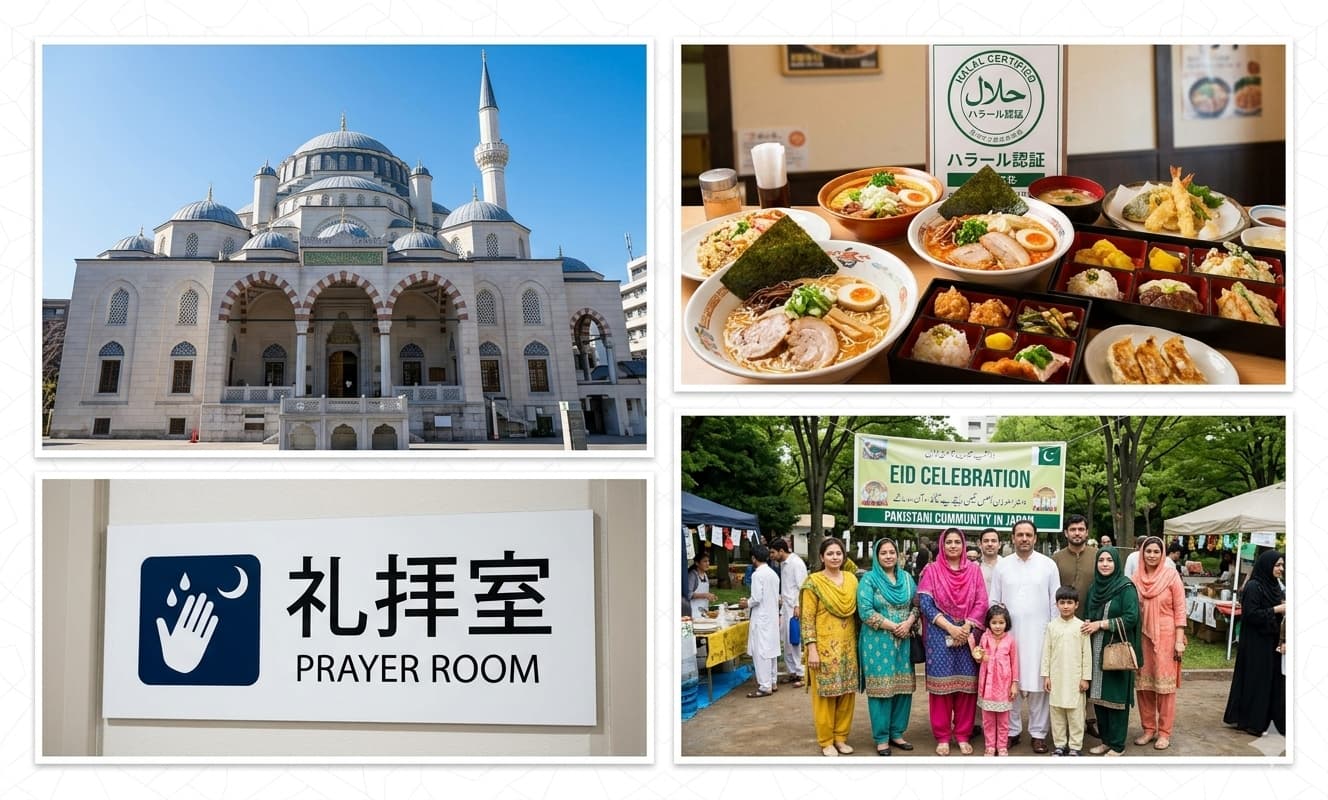
- Tokyo Camii — Japan’s largest and most beautiful mosque, located in Shibuya, Tokyo (with Turkish-Islamic cultural center)
- Kobe Mosque — Japan’s oldest mosque, established in 1935
- Nagoya Mosque, Osaka Ibaraki Mosque, Fukuoka Mosque, Sendai Mosque — all with active Muslim communities
- Prayer rooms available at most major universities, airports, shopping centers, and highway rest areas
- Over 110+ mosques and 400+ prayer spaces across Japan as of 2026
- Japan Halal Foundation and various apps (Halal Navi, HalalTrip) help you find prayer spaces anywhere
🍖 Halal Food Availability
- Halal restaurants are growing rapidly — over 1,500+ halal-certified restaurants in Japan as of 2026
- Tokyo hotspots: Shin-Okubo (Korean/halal town), Asakusa, Ueno, and Nishi-Kasai (“Little Pakistan”)
- Halal options available at many convenience stores (look for halal labels at Lawson and FamilyMart)
- Pakistani, Indian, and Bangladeshi grocery stores available in most major cities
- University cafeterias increasingly offering halal, vegetarian, and allergen-free meal options
- Major supermarkets (Gyomu Super, Hanamasa) carry imported halal meat
🤝 Pakistani Community in Japan (2026)
- Estimated 6,000–9,000 Pakistanis living in Japan (growing steadily)
- Strong communities in Tokyo (Nishi-Kasai, Shin-Okubo), Saitama (Yashio), Gunma (Isesaki, Ota), Aichi (Nagoya), and Osaka
- Active Pakistani student associations at University of Tokyo, Tohoku, Tsukuba, Nagoya, and other major universities
- Regular community events: Eid celebrations, Pakistan Day, cricket tournaments, and dawat (community meals)
- WhatsApp and Facebook groups for Pakistani students in every major city
🌸 Cultural Respect
Japan is known for its deep respect for other cultures and religions. Japanese society values harmony (和 / wa) and politeness. You will rarely face discrimination or hostility. Many Japanese people are genuinely curious about Islam and Pakistani culture. Employers and university staff will typically accommodate your prayer schedule and dietary requirements if you communicate your needs politely.
12. Why Choose Career Connection Consulting for Study in Japan?
At Career Connection Consulting, we don’t just help you with paperwork — we build a complete pathway from Pakistan to Japan and beyond. Here’s what makes us different from other consultants:
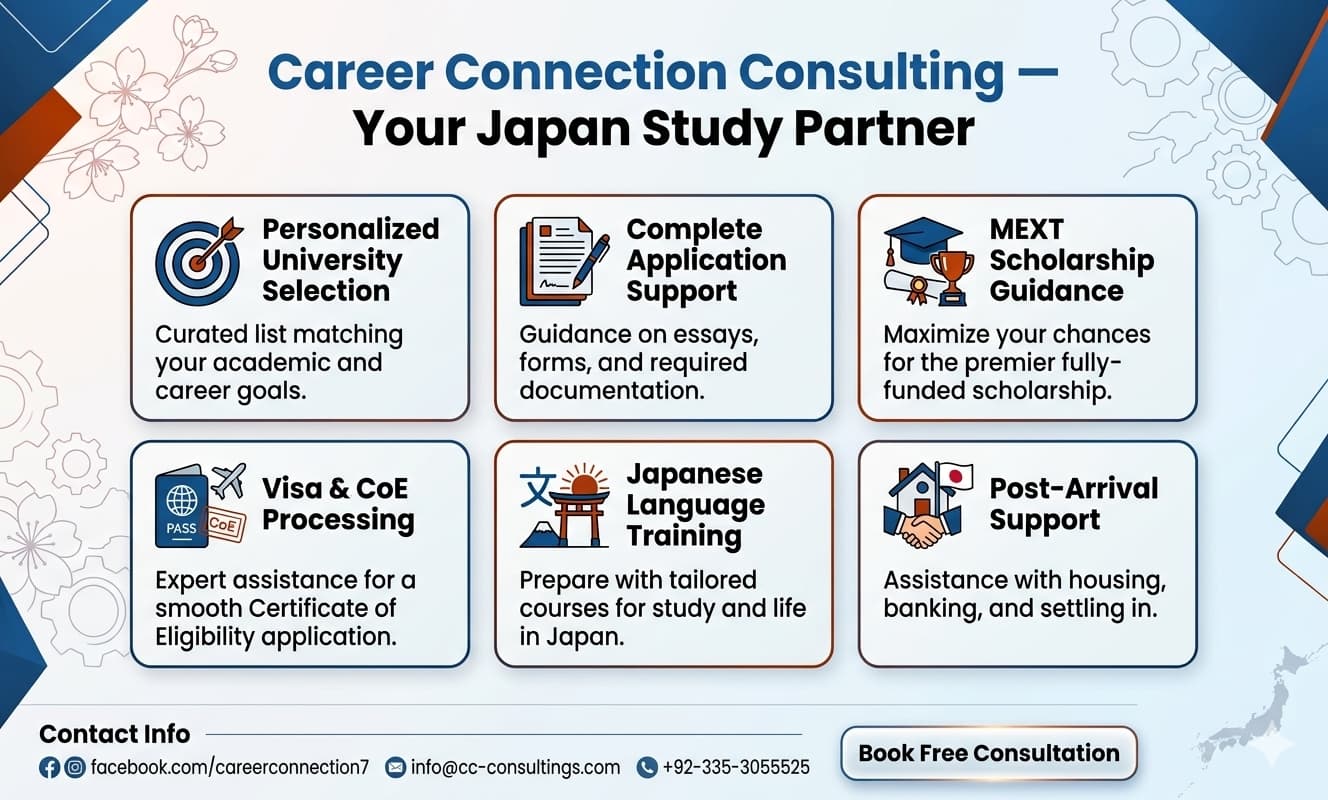
🎯 Personalized University Selection
We analyze your academic background, career goals, budget, and preferences to recommend the best Japanese universities and programs for YOU — not generic suggestions.
📝 Complete Application Support
From SOP/research proposal writing and document preparation to application submission and follow-up — we handle everything to maximize your admission chances.
🏆 MEXT Scholarship Guidance
We have a proven track record of helping Pakistani students win MEXT scholarships. Our MEXT preparation program covers application strategy, exam prep, interview coaching, and research proposal development.
🛂 Visa & CoE Processing
We guide you through every step of the Certificate of Eligibility and visa application process, ensuring zero documentation errors and maximum approval chances.
🇯🇵 Japanese Language Training
We offer Japanese language courses (online and in-person) to prepare you for life in Japan, from absolute beginner (JLPT N5) to business-level (JLPT N2).
🏠 Post-Arrival Support in Japan
Our support doesn’t end at the airport. We assist with accommodation, bank account setup, phone activation, ward office registration, part-time job search, and settling into Japanese student life.
Ready to Start Your Japan Journey? 🇯🇵✈️
Contact Career Connection Consulting today for a FREE consultation. Let us help you turn your dream of studying in Japan into reality — thousands of Pakistani students already have.
📞 Book Free Consultation Now📱 WhatsApp | ☎️ Phone | 🖥️ Online Zoom | 🏢 In-Person — Whatever works for you!
13. Frequently Asked Questions (FAQs) — Study in Japan from Pakistan
Does Japan accept Pakistani students?
Yes, absolutely. Japan actively welcomes Pakistani students through bilateral educational programs, the MEXT scholarship, and direct university admissions. As of 2026, over 4,000 Pakistani students are studying at Japanese universities, language schools, and vocational institutions. Japan and Pakistan have maintained strong diplomatic relations for over 70 years that support educational exchange. The Japanese Embassy in Islamabad and Consulate General in Karachi regularly promote study opportunities for Pakistani students.
Is IELTS required for Japan?
IELTS is not universally required for studying in Japan. For English-taught programs (SGU/G30), universities typically accept IELTS (6.0+), TOEFL iBT (80+), Duolingo English Test (105+), or PTE Academic (55+). Some universities waive the English test entirely if your prior education was conducted in English. For Japanese-taught programs, JLPT scores are required instead of English tests. For the MEXT scholarship, IELTS/TOEFL is recommended to strengthen your application but is not always mandatory — the exact requirement depends on the specific MEXT category and university.
How much does it cost for a Pakistani student to study in Japan in 2026?
The total first-year cost for a Pakistani student in Japan ranges from approximately PKR 27–53 lakhs depending on the institution and city (at 2026 exchange rates). National university tuition is approximately 535,800 JPY (~PKR 10.4 lakhs) per year, while private universities charge 800,000–1,500,000 JPY (~PKR 15.6–29.3 lakhs). Monthly living costs range from 70,000–155,000 JPY (~PKR 1.37–3.02 lakhs) depending on the city — Tokyo being the most expensive. However, scholarships, tuition waivers (25–100%), and part-time work income (80,000–120,000 JPY/month) can significantly reduce out-of-pocket costs. MEXT scholars pay nothing — the scholarship is fully funded.
How much GPA is needed for Japan?
Most Japanese universities require a minimum GPA of 2.5 on a 4.0 scale for undergraduate programs and 3.0 for graduate programs. For competitive programs and the MEXT scholarship, a GPA of 3.5 or above is strongly recommended. Language schools and some vocational programs have more flexible GPA requirements. At Career Connection Consulting, we help students with varying academic profiles find suitable institutions that match their qualifications.
How much bank balance is required for a Japan visa from Pakistan?
While there is no officially published minimum bank balance by the Japanese Embassy, based on our extensive experience at Career Connection Consulting processing hundreds of successful cases, we recommend showing approximately PKR 35–60 lakhs (2.0–3.5 million JPY) in the sponsor’s bank account. The account should demonstrate consistent deposits and activity over the last 6 months — not lump-sum deposits made just before the application, which may raise red flags and lead to CoE rejection. Immigration authorities want to see genuine, sustained financial capacity.
Can I work in Japan with a student visa?
Yes. International students in Japan can work up to 28 hours per week during the academic term and up to 40 hours per week during official school vacations. You must obtain a “Permission to Engage in Activity Other Than That Permitted” (資格外活動許可) from the Immigration Services Agency — this can be requested at the airport upon arrival. As of 2026, students typically earn 1,100–1,500 JPY per hour (~PKR 2,145–2,925), which can amount to 85,000–120,000 JPY per month (~PKR 1.66–2.34 lakhs). This is often enough to cover living expenses entirely.
Can I convert my student visa to a work visa in Japan?
Yes. If you receive a job offer from a Japanese employer before or after graduation, you can apply for a “Change of Status of Residence” from Student (留学) to a work visa such as “Engineer / Specialist in Humanities / International Services” (技術・人文知識・国際業務). If you haven’t secured employment by graduation, Japan offers a 6-month to 1-year job-hunting visa (Designated Activities / 特定活動) that allows you to stay, attend interviews, and even work part-time while searching. The Japanese government is actively encouraging more international graduates to remain and work in Japan.
How can I get a full scholarship to study in Japan from Pakistan?
The primary route to a full scholarship is the MEXT (Monbukagakusho) Scholarship, offered by the Japanese government. It covers full tuition, a monthly living stipend (117,000–145,000 JPY as of 2026), and round-trip airfare between Pakistan and Japan. Applications are submitted through the Embassy of Japan in Islamabad, typically opening in April–May each year for the following year’s intake. Other fully funded options include the ADB-Japan Scholarship Program (for Master’s students) and the JICA ABE Initiative. Career Connection Consulting provides comprehensive MEXT preparation and application support to maximize your chances of selection.
Is Japan friendly to Muslims and Pakistani students?
Yes, Japan is increasingly friendly and accommodating to Muslims. As of 2026, there are over 110 mosques and 400+ prayer spaces across Japan, including the iconic Tokyo Camii (Japan’s largest mosque). Over 1,500 halal-certified restaurants operate nationwide, and halal food is becoming more available in supermarkets and convenience stores. Most major universities provide prayer rooms and some offer halal meal options. Pakistani grocery stores and restaurants are available in cities like Tokyo (Nishi-Kasai), Saitama, Gunma, Nagoya, and Osaka. The Japanese culture deeply respects other religions, and Muslim students generally report very positive and welcoming experiences.
What is the age limit for a student visa in Japan?
There is no strict upper age limit for a general Japan student visa. However, the MEXT Undergraduate Scholarship requires applicants to be under 25 years of age, and the MEXT Research Scholarship requires applicants to be under 35. Japanese language schools generally prefer applicants under 30, though some accept students up to 35. Applicants over 30 may be asked to provide additional justification for their study plan, especially if there are significant gaps in educational or employment history. Career Connection Consulting can help you present a strong case regardless of your age.
Does Japan give visa easily to Pakistani students?
Compared to many Western countries (USA, UK, Canada, Schengen), the Japan student visa process is relatively straightforward for Pakistani applicants. The most critical step is obtaining the Certificate of Eligibility (CoE), which is processed in Japan by immigration authorities. Once the CoE is approved and received, the visa application at the Japanese Embassy in Islamabad or Consulate General in Karachi has a very high approval rate — estimated at 95%+ as of 2026. The embassy visa processing typically takes only 5–7 working days. Working with Career Connection Consulting ensures your CoE documentation is error-free, complete, and consistent, which is the single most important factor in avoiding rejection.
How long is a student visa valid for Japan?
Japan student visas are typically issued for 1 year and 3 months to 2 years and 3 months, depending on the program type and duration. Language school visas are usually 1 year 3 months, renewable up to a total of 2 years. University degree program visas are issued matching the program length and are renewable as needed. MEXT scholarship holders receive visas matching their full scholarship period. All renewals are processed at the local Immigration Services Bureau in Japan before the current visa expires — usually a straightforward process if you maintain good academic standing and attendance.
Which course is best in Japan for Pakistani students?
The best courses in Japan for Pakistani students in 2026 — based on employability, salary potential, and ease of finding post-study work — are: (1) Information Technology and Computer Science, (2) Mechanical and Automotive Engineering, (3) Electrical Engineering and Robotics, (4) Artificial Intelligence and Data Science, (5) Business Administration / MBA, and (6) Nursing and Caregiving. IT and engineering graduates are in particularly high demand due to Japan’s severe tech workforce shortage — the government projects needing 790,000+ IT professionals by 2030. Career Connection Consulting helps students choose programs aligned with both their interests and Japan’s labor market demands.
Can I study in Japan from Pakistan online?
While some Japanese universities offered online courses during the COVID era, as of 2026, most programs require in-person attendance in Japan. However, you can start your preparation online from Pakistan — including Japanese language courses, MEXT scholarship application preparation, and university research — all of which Career Connection Consulting offers through online consultations via WhatsApp and Zoom. Some universities also allow online submission of applications and preliminary interviews via video call before you travel to Japan.
Your Japan Dream Starts Here 🇯🇵🎓
Whether you’re looking for a fully funded MEXT scholarship, admission to a top Japanese university, or step-by-step visa guidance — Career Connection Consulting is your trusted partner. Join hundreds of successful Pakistani students we’ve already placed in Japan.
📞 Book FREE Consultation 🎓 Read MEXT Scholarship Guide📍 www.cc-consultings.com | Available across Pakistan: Karachi, Lahore, Islamabad, Rawalpindi & Online